
However, RBI would continue to nudge banks to cut lending rates
The Reserve Bank of India is likely to cut policy rates by 0.25 per cent and keep the cash reserve ratio unchanged at its policy review next week, on the back of slower-than-expected growth and more encouraging inflation readings, says a report by HSBC.
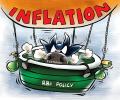
The RBI on Friday retained inflation forecast for FY23 at 6.7 per cent amid uncertain price trajectory on "geopolitical shocks" and on hope that inflationary pressures would ease with pick-up in kharif sowing and supply chain improvements. In its previous monetary policy review in June, it had projected retail inflation for 2022-23 at 6.7 per cent, higher from 5.7 per cent forecast in April. The six-member Monetary Policy Committee (MPC) unanimously decided to raise the benchmark repo rate by a steep 50 basis points to 5.40 per cent with immediate effect to tame inflation while supporting growth.
He also affirmed that over time, as the government finances improve, the SLR will be brought down further.

The first task before him is to get used to the idea of working with the Monetary Policy Committee

The criticism that the Reserve Bank of India was behind the curve in hiking interest rate to tame rising inflation is unfair, former RBI Governor D Subbarao said on Wednesday and asserted that it is difficult for any central bank to anticipate the future more accurately. Earlier this month, Monetary Policy Committee (MPC), the central bank's rate-setting panel, surprised the markets with a 40 basis points hike in repo rate in an off-cycle policy meeting. It was also the first rate hike after August 2018, amid spiralling inflation.

The rupee had lost 52 paise to close at 54.08 against the dollar on Tuesday on heavy month-end dollar demand from importers and corporates.

With the RBI infusing Rs 7.5 lakh crore in liquidity -- and possibly more in the future -- the short- to medium-term corporate bond market is expected to benefit.

Voices from the Treasury are clamouring for lowering rates as this would boost demand.

The minutes of the December MPC meet reveal members felt the current spike in the headline inflation rate was due to a temporary supply shock on the food front, expected to moderate by the second quarter of 2020-21.
.jpg)
CII hopes that the RBI would not wait for the next quarterly review but intervene sooner if the economic condition warrants a mid-course correction.

The RBI's Review is completely at odds with its actions.
In its mid-term review of the 2006-07 monetary policy, the central bank had raised the ceiling on overseas borrowings by banks to 50 per cent of their unimpaired tier-I capital (equity, reserves plus perpetual debt) from 25 per cent.

The core inflation is down and there is a need to push growth.
Minutes of the MPC meeting show Das felt economy needs more monetary stimulus as inflation outlook remains uncertain.

Five of the six external members had suggested that the central bank should reduce the policy rate.
The Reserve Bank of India on Friday decided to keep the benchmark interest rate unchanged at 4 per cent but maintained an accommodative stance as the economy is yet to recover from the impact of the second Covid wave.

Reserve Bank Governor Shaktikanta Das on Wednesday said underlying economic activity in India continues to be strong, but external factors will cause some "dent" to the economy. Speaking at the BFSI Insight Summit 2022 organised by Business Standard, Das said the RBI tracks 70 fast moving indicators and most of them are in the "green box". It is the external sector, mired by a fear of recession or clear visibility about slowing growth in a large part of the world, where the challenges lie, he said, adding that the impact of external demand will "dent" the economy.

In a tightening cycle, a premature pause in monetary policy action would be a costly policy error, Reserve Bank Governor Shaktikanta Das opined while voting along with five other members of the MPC for raising the key lending rate by 35 basis points earlier this month, according to the minutes of the meeting released on Wednesday. Prior to the December hike in repo rate, the RBI had raised the key short-term lending rate by 190 bps in four tranche.

India is gearing up to introduce a six-member monetary policy committee that would vote on interest rates.

The Reserve Bank will present the mid-quarter Monetary Policy Review on Tuesday.

Foreign investors withdrew Rs 10,355 crore from the country's equity markets in the last four trading sessions this month due to sweeping tariffs imposed by the US on most nations, including India. The outflow occurred after a net investment of Rs 30,927 crore in the six trading sessions from March 21 to March 28. This infusion helped reduce the overall outflow for March to Rs 3,973 crore, according to data from the depositories.

April policy could be all about RBI communication.

Retail inflation dipped marginally to a nearly six-year low of 3.34 per cent in March due to a decline in prices of vegetables and protein-rich items. The Consumer Price Index (CPI) based inflation was 3.61 per cent in February and 4.85 per cent in March last year.

'Investment creates capacity and reduces inflation. Income, employment, and savings rise.'

Three policymakers aware of the central bank's deliberations on the Budget said they are combing through the numbers to test how Jaitley struck a balance, and question some of the assumptions.

The Monetary policy committe comprising 6 members voted 6-0 in the favour of the rate cut.
The halt in the RBI's monetary tightening drive comes after 13 hikes since March, 2010.

The Reserve Bank of India's rate-setting panel will go for a 0.35 per cent hike in the key repo rate at its meeting next week, an American brokerage said on Wednesday. The hike will be accompanied by a change in the policy stance to "calibrated tightening", Bofa Securities said in a report published ahead of the Monetary Policy Committee (MPC) resolution which is set to be announced on August 5. RBI has hiked the rate by a cumulative 0.90 per cent in two tightening moves in May and June, responding to the runaway headline inflation which has consistently overshot the upper end of the target set for the central bank for many months.

Reserve Bank will hold its first bi-monthly monetary policy review for 2016-17 on Tuesday.

The Reserve Bank on Friday took steps towards normalisation of liquidity management to pre-pandemic levels, with the introduction of the standing deposit facility (SDF) as the basic tool to absorb excess liquidity, and narrowing the liquidity adjustment facility (LAF) to 0.50 per cent from the 0.90 per cent. Governor Shaktikanta Das said the SDF will be at 3.75 per cent, 0.25 per cent below the repo rate and 0.50 per cent lower than the marginal standing facility (MSF) which helps the banks with funds when required. The SDF has its origins in a 2018 amendment to the RBI Act and is an additional tool for absorbing liquidity without any collateral.

Relations between the Mint Road and North Block have often been frosty, with the former's calls for lowering rates being the biggest point of difference
The 30-share Sensex ended down 113 points at 20,570 and the 50-share Nifty closed 44 points lower at 6,101.

The wholesale inflation rose to a 13-month high of 1.26 per cent in April fuelled by rising prices of food articles, especially vegetables, amid expectations of RBI holding interest rates in the policy review next month. The wholesale price index (WPI) based inflation has been rising for two months in a row.

The policy guidance marks a clear shift in RBI's monetary policy stance towards addressing growth risks while not de-emphasising the objective of containing inflation

The industry urged the central bank to consider a rate even before the next monetary policy review on July 30.

Raghuram Rajan on February 2 left the key interest rate unchanged.

The Reserve Bank of India (RBI) on Friday kept the key repo rate unchanged at 4 per cent in view of rising inflation and faint signs of economic growth amid the gradual lifting of coronavirus related countrywide lockdown.
